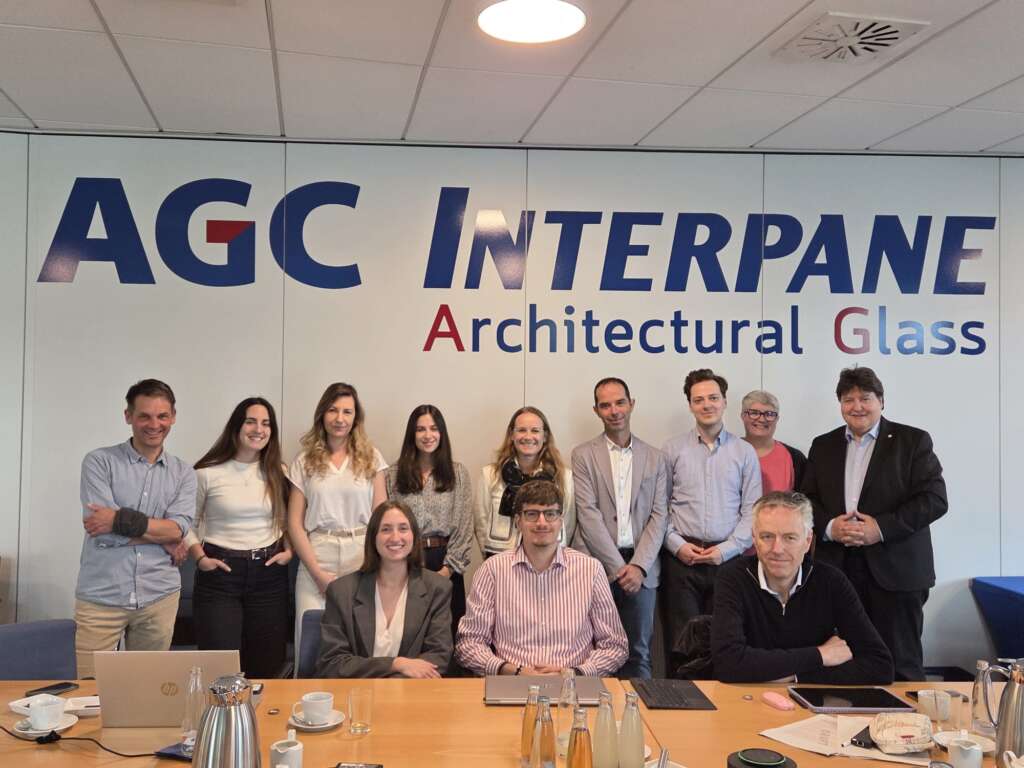
The Horizon Europe project NANOBLOC has reached its conclusion. On 16 June 2026, the consortium gathered at AGC Interpane in Lauenförde, Germany, for its final meeting — an opportunity to review the project’s main scientific, technological and exploitation outcomes and to define the next steps for valorisation beyond the funded action.
Coordinated by Politecnico di Torino and bringing together research organisations, universities and industrial partners — including Friedrich-Alexander-Universität Erlangen-Nürnberg (FAU) and Fundación TEKNIKER, both members of KMM-VIN — NANOBLOC set out to develop sustainable antimicrobial, antiviral and antifungal nanocoatings for applications such as air filtration systems, textiles and high-traffic surfaces.
The project tackled a highly relevant challenge: developing durable, safe and scientifically validated surface solutions that can contribute to infection prevention and to preparedness against future health crises.
From laboratory research to industrial upscaling
One of NANOBLOC’s strongest achievements was the successful transition from lab-scale research to industrially relevant coating processes. Several coating technologies were developed, optimised and tested on different substrates, with close attention to performance, durability, health and environmental safety, and scalability.
Some of the most promising coatings showed very high antibacterial and antiviral effectiveness, particularly selected silver-containing nanostructured systems. POLITO–AGC SiZrOx-Ag coatings demonstrated strong antiviral activity against HCoV-OC43 on both textile substrates and polymeric air filters, with infectivity inhibition above 99% under the tested conditions. Antibacterial testing further confirmed that activity persisted in selected upscaled coatings even after repeated simulated washing cycles.
A key industrial milestone was the upscaling of the co-sputtering process for Ag-SiZrOx coatings by AGC Interpane, with technical support from Politecnico di Torino. The work progressed from lab-scale feasibility studies to sheet-to-sheet trials and finally to roll-to-roll processing, enabling the production of coated textile rolls under conditions much closer to real industrial implementation — while maintaining antibacterial activity in selected samples, including after washing.
Standardization as a lasting legacy
Beyond the coatings themselves, NANOBLOC placed strong emphasis on standardization and on the need for reliable, fit-for-purpose testing methods. This matters especially in the antimicrobial and antiviral coating sector, where market claims must be backed by robust, science-based evidence and where existing standards do not always capture durability or real-use conditions.
With the support of the project’s standardization partner, the consortium contributed to the preparation and publication of three CEN Workshop Agreements (CWAs). These outputs are among the project’s most important long-term impacts, providing a practical basis for the more harmonised assessment of antimicrobial, antiviral and antifungal nanocoatings and supporting future industrial uptake of validated technologies.
A collaborative effort across the value chain
The final meeting highlighted the strength of the NANOBLOC consortium model: a co-creation approach connecting materials science, coating technologies, microbiology, characterization, industrial engineering, validation, standardization and exploitation. This interdisciplinary structure allowed the project to address the full innovation chain — from coating formulation and mechanistic understanding to durability assessment, prototype production and potential market deployment.
The consortium also discussed post-project exploitation routes, further validation needs and future collaboration opportunities with industrial stakeholders and European sister projects.
Looking beyond the project
NANOBLOC closes with significant achievements across several dimensions: high-performing antibacterial and antiviral coatings, a deeper understanding of mechanisms and durability, the industrial upscaling of selected technologies, concrete standardization outputs and a clearer pathway toward application-oriented validation. Together, these results confirm the relevance of antimicrobial and antiviral surface technologies within a broader strategy for safer indoor environments and better preparedness against future infectious threats.
The meeting at AGC Interpane marked both the conclusion of the funded project and the start of a new phase, in which the most promising results can be further validated and transferred toward real-world applications.
Key NANOBLOC outcomes
- Strong antibacterial and antiviral performance for selected coating systems
- Industrial upscaling of selected coating processes, including co-sputtering and roll-to-roll deposition
- Durability assessment after ageing, washing and application-relevant stress conditions
- Contribution to three CEN Workshop Agreements supporting the standardization of antimicrobial and antiviral nanocoating assessment
- A strengthened European research–industry network for future infection-prevention surface technologies
Many thanks to all partners for the excellent collaboration, and to AGC Interpane for hosting the final meeting.